

You came to a foreign land many years ago, either for employment or personal reasons or perhaps to create a whole new life from scratch. And in the midst of filing visa papers, settling into a new address, and leading a new life in this new land, some share certificates buried inside an old file folder in India were completely forgotten.
And then one fine day, it strikes you. Your brother informs you of it. You accidentally come across an old dividend warrant when cleaning up your late parents’ property.
You begin to think whether the shares are yours and how you could get back your shares from here.
Yes, they are indeed. And yes, they can be recovered by you as a Non-Resident Indian fully and legally without even visiting India once. There are however a few important aspects specific to the process as applicable to NRIs that are rarely comprehensively discussed in any one document.
This is your destination. No matter if you live in America, United Kingdom, United Arab Emirates, Australia, Canada, or Singapore — here is all you need to know about NRI IEPF Claim filing and NRI Share Recovery Services in 2026.
Why So Many NRI Shares End Up in IEPF
Before addressing the question of how these investments end up here, one must first understand why — since it turns out that the reasons provided by NRIs are similar in most cases.
Most NRIs or even their parents would have invested in stocks during their stay in India. Later on, due to changing of address and country of residence, they could not receive communications from the companies or might even have lost the certificates while traveling. This way, these investments got lost, and dividends continued to go unpaid.
There are a number of causes for this issue: changes in addresses and bank account numbers when moving abroad without updating; seven or more years of unclaimed dividends; stocks kept in physical format without any dematerialisation; lack of registration of nominees, leading to the inability to inherit the investments due to loss of documents; and finally, dormant accounts.
In all cases, the outcome is the same. The seven-year period on unclaimed dividends expires, and the shares become the property of IEPF. As of 2025, IEPF manages over ₹82,000 crore worth of unclaimed stocks and dividends in over 1,500 listed firms, showing the extent of lost value that remains unclaimed.
The NRI community’s share of unclaimed stock is disproportionately higher. Accumulation of unclaimed shares resulting from decades of purchase of stocks while residing in India — followed by many years of missing dividend information after relocating overseas — creates substantial NRI-related unclaimed shares.
Can NRIs Recover Shares from IEPF Without Visiting India?
It is probably the first question on everyone’s mind among NRI individuals, and thankfully, the answer is positive.
No personal visit to the organisation, its registrar, or the IEPF Authority is required for NRIs to recover shares from abroad by following a set procedure.
The IEPF-5 form is filed online. Physical files and documents are sent to the nodal officer of the company or its RTA via courier. Share transfer takes place to the demat account while dividends are sent directly to your bank account. In fact, everything is done remotely if you manage to complete all the paperwork correctly.
That is where problems usually arise for most NRIs. The NRI IEPF claim process follows the same steps as those for resident Indians — with just a few important exceptions.
What Makes the NRI IEPF Claim Different
NRIs may need assistance when it comes to notarisation, Power of Attorney, OTPs, or coordinating from abroad.
It takes a lot of effort and time to understand the regulations of India under IEPF, SEBI, FEMA, RBI, and tax laws — particularly from overseas. In recovering their shares, the involvement of various stakeholders including the registrar, company, court, and government agencies is inevitable. Moreover, there are varying regulations within each company and registrar. An apostille, notarisation, or jurisdictional filing may be needed by NRIs. Time zone, mailing, and emailing delays could make coordination overseas quite tough.
Let us discuss each challenge specifically:
Different KYC documents — Indians residing in India would provide their PAN and Aadhaar cards in lieu of KYC documentation. However, NRIs would provide the self-attested copy of their passports or self-attested copy of their Overseas Indian Card (OIC) provided by the Ministry of Home Affairs, together with whatever document is available. For NRO/NRE accounts, NRIs would have to provide a self-attested copy of their passport, OCI/PIO card, or driving licence.
Aadhaar OTP problem — The MCA21 portal uses Aadhaar-linked OTP for filing Form IEPF-5. Many NRIs do not have an active Aadhaar card linked to an Indian mobile number. Without this, online filing becomes a significant hurdle.
15-day physical submission period — Post electronic filing, the documents will have to reach the company within 15 days. When done from overseas, this implies that the applicant needs to organise international shipping on the very day the document is electronically filed — or at the very least within one or two days from it. Failure to do so will result in an automatic rejection.
Requirements regarding document authentication — Many documents issued overseas may require apostille (in case of documents submitted by Hague Convention members), or attestation by the Indian Embassy or Consulate for use in legal processes in India. The POA document needs to be apostilled through competent authorities of the country which is a signatory to the Hague Convention. Upon arrival in India, the document needs to be stamped in the local Collector’s office within three months.
Demat account type — NRIs cannot use a regular resident demat account for receiving IEPF shares. You need either an NRO demat account (for non-repatriable holdings) or an NRE demat account (for repatriable holdings). Many NRIs who bought shares before moving abroad have old resident demat accounts that are now invalid for their status.
FEMA compliance — All financial transactions involving NRIs are subject to Foreign Exchange Management Act (FEMA) regulations. Receiving shares through IEPF and any subsequent sale of those shares must comply with applicable FEMA rules.
Step-by-Step: How NRIs Can Recover Shares from IEPF
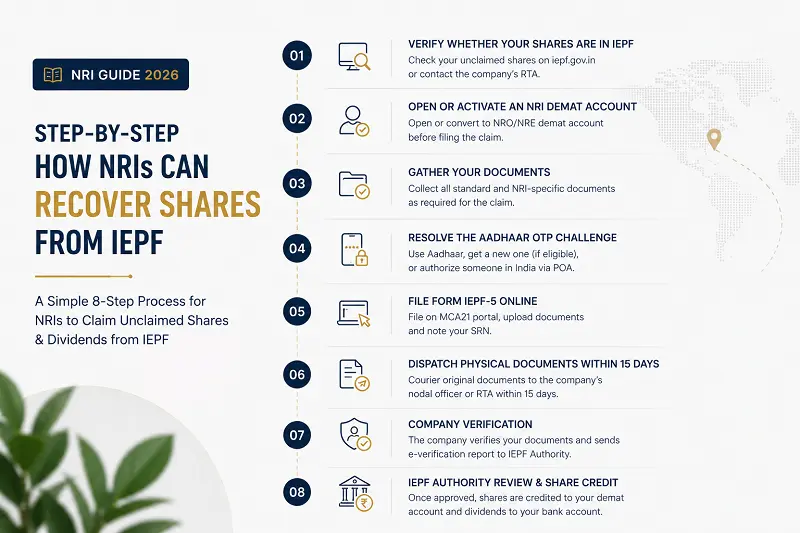
Step 1: Verify Whether Your Shares Are in IEPF
First of all, check the facts.
Go to the iepf.gov.in website and use the search engine for unclaimed shares. This will give you the result by searching on the name of the shareholder, folio, or the PAN card. Another way to verify your status is contacting the RTA of the company directly — since RTAs like KFintech, Link Intime, or Bigshare keep detailed records of such transactions.
There is also the option of looking at the investor relations section of the company, since many listed companies keep a detailed record of shares that have been sent to the IEPF.
In case you are unsure about the companies in which you or someone from your family held stocks, you can start by looking into old annual reports, dividend warrants, or bank statements where dividend payments were received.
Step 2: Open or Activate an NRI Demat Account
This is something peculiar to NRIs and has to be done prior to filing the form — not after.
The IEPF credits shares in your demat account, provided that the demat account is an active one. Being an NRI, you will require either of these accounts:
NRO Demat Account — This is linked with your NRO bank account and is suitable for those shares which cannot be repatriated to other countries. Any income generated in the form of dividends on shares held by you is taxable in India.
NRE Demat Account — This is linked with your NRE bank account, which allows complete repatriation of the investment along with any gains or income earned from your investment.
In case you had a resident demat account earlier before going abroad, then this has to be converted into an NRO demat account. For this, please contact your Depository Participant with your updated KYC documents.
Make sure this account is fully active and your name on the demat account matches your name on all other documents exactly.
Step 3: Gather Your Documents
The document list for an NRI IEPF claim has both the standard requirements and NRI-specific additions.
Standard documents (all claimants):
- Printed and signed Form IEPF-5 (with SRN from online filing)
- SRN acknowledgement (self-attested)
- Original indemnity bond on appropriate stamp paper (state-specific value)
- Original advance stamped receipt with ₹1 revenue stamp, cross-signed
- Proof of entitlement (folio number, share details, company name — confirmed with RTA)
- Original share certificate (physical) or demat transaction statement
- Cancelled cheque from your NRO/NRE bank account (with name, IFSC, and account number visible)
- Client Master List (CML) from your Depository Participant (NRO/NRE demat account)
NRI-specific KYC documents:
- Self-attested copy of passport or self-attested copy of Overseas Indian Card (OIC) issued by MHA. For foreigners of Indian origin, a PIO card apostilled as per the Hague Convention is required
- Foreign address proof (bank statement, utility bill, or government-issued ID showing your current overseas address)
- PAN card (mandatory for all claimants regardless of residency status)
If the original shareholder has passed away (legal heir NRI claimants):
- Original death certificate
- Legal heir certificate or succession certificate from a competent court
- Probate of will (if applicable)
- No-objection certificate from other heirs
- Affidavit of indemnity (notarised, on stamp paper)
- For foreign documents — apostille or Indian Embassy/Consulate attestation as applicable
Document consistency rule — All NRI IEPF claim documents should be exactly consistent. In case of NRIs, the requirement is complicated since there might be discrepancies between the names on their old Indian share certificates and those on passports. It is also important to note that NRIs have to use passport/OCI/PIO documents and foreign address proofs.
In case of name discrepancy between the passport and old share certificate, an affidavit, marriage certificate, or government gazette could be used as evidence.
Step 4: Resolve the Aadhaar OTP Challenge
This is one of the most practically frustrating aspects of the NRI IEPF claim process.
Form IEPF-5 filing on the MCA21 website involves OTP authentication tied to your Aadhaar number. Without an Aadhaar number which is linked to an operational Indian mobile phone number, you are stuck at this very beginning step.
Below are the possibilities open to NRIs:
Option 1: Using an existing Aadhaar number — This is an option for NRIs who have previously possessed an Aadhaar card and it is still linked to a phone number from where they have access to it via either one of their relatives in India or using a roaming SIM number.
Option 2: Obtaining an Aadhaar number — If you are eligible for an Aadhaar number (have an Indian passport and have stayed in India for 182 days within the previous 12 months), you are qualified to apply for it.
Option 3: Giving Power of Attorney to someone in India — A trustworthy relative or any person in India, given authority through an effective POA, can file your case on your behalf using his/her credentials with an active Aadhaar number. Such a Power of Attorney should have been signed outside India, notarised, apostilled (or attested by the Indian Embassy), and registered inside India.
The Power of Attorney route is the most widely used solution among NRIs having trouble with the Aadhaar OTP authentication. Power of Attorney conditions vary for NRIs based on their respective countries of residence — like USA, UAE, UK, Australia, and Singapore.
Step 5: File Form IEPF-5 Online
Once the Aadhaar OTP challenge is resolved — either directly or through a POA holder — file Form IEPF-5 on the MCA21 portal at mca.gov.in.
Fill in:
- Company name and CIN (Corporate Identity Number)
- Your folio number and number of shares
- Financial year in which shares were transferred to IEPF
- NRO/NRE demat account details (DPID and 16-digit Client ID)
- NRO/NRE bank account details for dividend credit
Upload all scanned documents in the prescribed format. Submit and download the acknowledgement. Note your Service Request Number (SRN) immediately — this is your tracking reference.
Update the postal receipt on the portal as soon as you dispatch physical documents. Without this update, your file does not move forward.
Step 6: Dispatch Physical Documents Within 15 Days
This is the stage where most NRI IEPF claim attempts fail — not because the documents are wrong, but because the 15-day window is missed.
When applying from overseas, you must have all your physical documents ready to courier immediately after your online application process is completed. International courier services such as DHL, FedEx, or others to India generally take between three and five days — thus, you really do not have much room to play around.
Your physical documentation must be couriered to the company’s nodal officer or its RTA office and needs to contain the following:
- Signed IEPF-5 form (having SRN)
- Indemnity bond in the original format
- Advance stamped receipt in the original
- Self-attested copies of KYC documents and other supporting documents
- Special NRI documents (passport copy, OCI/PIO card, proof of foreign address)
- Other documents relevant to your case
Send via a tracked international courier service. Keep the airway bill, tracking number, and delivery confirmation. Mark the envelope “IEPF-5 Claim Submission” on the outside.
Step 7: Company Verification
After you have submitted your physical documents, the nodal officer or RTA verifies your claim — identity proof, folio information, document validity, and validity of the indemnity bond documentation.
Once the documentation is verified, an e-verification report is sent by the company to the IEPF Authority within 30 days of your document submission.
In case of NRI IEPF claim applications, the company verification process can be lengthy in certain cases owing to due diligence required for verification of documents attested or apostilled outside India. If you receive any communication from the company asking for more information or documents, please comply without delay.
Step 8: IEPF Authority Review and Share Credit
Once the IEPF Authority receives the company’s e-verification report and approves the claim, shares are credited to your NRO/NRE demat account and outstanding dividends are transferred to your NRO/NRE bank account electronically.
The overall timeline for NRI Share Recovery from IEPF is typically three to six months for a clean, well-documented claim. With the current backlog at the IEPF Authority, however, total processing time can extend to 12 to 24 months from the date of filing. Senior citizens aged 75 and above receive priority processing — a dedicated helpline (011-23441727) and email (seniorcitizen.iepfa@mca.gov.in) are available for them.
What Happens to the Shares After Recovery?
Once your shares are credited to your NRO demat account, you regain full ownership. You can:
- Hold them in your NRO demat account and continue receiving dividends (subject to TDS)
- Sell them through your NRO trading account, with proceeds credited to your NRO bank account
- Transfer them to an NRE demat account in certain cases, subject to FEMA guidelines and applicable compliance
For NRIs considering repatriation of sale proceeds, consult a FEMA-compliant tax advisor to understand the applicable rules for your specific share category and country of residence.
NRI IEPF Claim for Inherited Shares — Special Considerations
For NRIs claiming shares that belonged to a deceased family member — a parent, grandparent, or spouse — the process adds a significant legal documentation layer.
In addition to the standard succession documents (death certificate, legal heir certificate or succession certificate, NOC from other heirs, probate of will if applicable), NRI claimants face an additional challenge: these documents, if obtained or signed abroad, must be properly authenticated.
For NRIs, foreign documents must be apostilled or attested by an Indian Embassy before they can be used in Indian legal proceedings.
Steps in the apostille procedure are as follows:
- Notarising the document in your home country through a notary public
- Sending it to the relevant agency that will issue the apostille certificate (the agency differs between countries — it is usually the Secretary of State in the USA and the Foreign, Commonwealth & Development Office in the UK)
- Shipping the apostilled document to India for filing in the NRI IEPF claim
This step may take a few weeks and should be planned well ahead of time.
When you have inherited shares with a value higher than ₹2 lakhs, some additional documents such as the NOC of the other heirs and the relinquishment deed need to be obtained from the company prior to verification. This might be the most complicated part of the whole process.
Tracking Your NRI IEPF Claim Status
Post filing, monitor your application periodically using your SRN through the MCA21 portal. Using your registered email address, access ‘My Application’ and use your SRN.
Important status codes and their implications for NRI applications:
“Pending for Action” — You have not uploaded the postal receipt details on the portal. Do so at once after sending out physical forms.
“Under Processing” — Your form is under verification by the firm or the IEPF Authority. This step is the longest.
“Resubmission” — There is an error in your form. Only 15 days are left to make corrections. If you are an NRI, then the deadline of 15 days is very restrictive since collecting and verifying replacement forms requires some time.
“Approved” — Your claim has been approved. Shares will credit to your demat account within 45 to 60 days.
Check your registered email — including your spam folder — regularly. All official IEPF communications arrive via email. A missed resubmission notice can mean your claim is rejected and the entire process restarts.
Frequently Asked Questions — NRI IEPF Claims
Can NRIs file an IEPF claim without visiting India?
Yes. There is no requirement for a personal visit to the company, registrar, or IEPF. NRIs can recover shares from abroad without needing to visit India by following the defined recovery process.
What KYC documents do NRIs need for an IEPF claim?
NRIs must submit a self-attested copy of their passport or Overseas Indian Card (OIC) issued by MHA, along with any other available documents. For NRO/NRE accounts, a valid passport, OCI card, PIO card, or driving licence is acceptable. PAN card is mandatory for all claimants.
Can NRIs use Aadhaar for the IEPF-5 filing OTP?
Only if you have an active Aadhaar linked to an Indian mobile number accessible to you. If not, the most common solution is granting a Power of Attorney to a trusted person in India who files on your behalf.
What demat account should NRIs use for an IEPF claim?
You need an active NRO or NRE demat account. Old resident demat accounts must be converted to NRO status before filing. Ensure the account is active and the name matches all other documents.
Do NRI documents need apostille for an IEPF claim?
Documents signed abroad — particularly Power of Attorney, legal heir affidavits, or succession documents — typically need to be notarised and either apostilled (for Hague Convention member countries) or attested by the Indian Embassy or Consulate.
How long does an NRI IEPF claim take?
The timeline is the same as for resident Indians — three to six months for a clean claim, potentially 12 to 24 months given the current IEPF Authority backlog. However, NRI IEPF claim cases often take longer at the document preparation stage due to apostille and authentication requirements.
Can NRI legal heirs recover shares from IEPF after the original shareholder’s death?
Yes. NRI legal heirs can recover shares from abroad through the IEPF process. They need the standard succession documents (death certificate, succession certificate or legal heir certificate, NOC from other heirs) plus appropriate foreign document authentication (apostille or embassy attestation).
Can NRIs repatriate money from IEPF share recovery abroad?
Dividends credited to your NRO account are subject to TDS and can be repatriated up to USD 1 million per financial year after applicable taxes. Sale proceeds of shares held in NRO demat accounts are subject to FEMA regulations. Consult a qualified FEMA advisor for your specific situation.
When to Use Professional NRI Share Recovery Services
The NRI IEPF claim process is doable independently — for NRIs who have an active Aadhaar, an NRO demat account already in place, consistent documents, and the ability to courier within the 15-day window.
For most NRIs, however, at least one of these conditions does not hold. And that is where professional NRI Share Recovery Services prove their worth:
Aadhaar OTP is not accessible — The team files through properly executed POA, managing the registration and activation process in India.
Physical documents need to reach India within 15 days — India-side coordinators handle receipt, verification, and submission without missing the window.
Documents need apostille or embassy attestation — Guidance on the exact authentication route based on your country of residence.
Inherited shares with cross-border succession documentation — End-to-end management of succession documents across multiple jurisdictions.
Old resident demat account needs NRO conversion — Coordinated with your Depository Participant as part of the recovery process.
Previous claim was rejected — Fresh review of the rejection reason and corrected resubmission.
Our IEPF Claim Services cover all these scenarios. For NRIs, we serve as your on-ground India support — so you never have to worry about a missed deadline, a lost document, or a resubmission notice arriving in your inbox with a 15-day clock.
Final Word
Your shares did not disappear when you moved abroad. They did not expire when dividends went unclaimed. They are sitting in IEPF — a government-held account — waiting for you to come forward and claim them.
The NRI IEPF claim process has more moving parts than the resident Indian version. The documents are more complex, the logistics more demanding, and the coordination required across countries, time zones, and multiple Indian authorities is genuinely challenging.
But thousands of NRIs complete this process successfully every year. The ones who succeed are the ones who understand the specific requirements for NRI IEPF claim filing, prepare meticulously, and track their claim actively.
Whether you navigate the process yourself or lean on our NRI Share Recovery Services and IEPF Claim Services for end-to-end support — the most important step is to begin.
Your shares are waiting. They have been waiting a long time. Let’s bring them home.
Ready to start your NRI IEPF claim?
Our team is on the ground in India and ready to support you every step of the way.
Contact Us today — +91 88829 91427 | +91 80768 85539 | info@expertvuw.in