

Have you discovered old share certificates in a family locker or noticed that dividend payments from a long-held investment stopped arriving years ago?
Under Section 125 of the Indian Companies Act, 2013, if dividends on shares remain unclaimed for 7 consecutive years, the company is legally required to transfer both the unclaimed dividends and the underlying shares to the Investor Education and Protection Fund (IEPF) authority under the Ministry of Corporate Affairs (MCA).
While recovering assets from the government may seem daunting, professional IEPF Claim Services can simplify the entire recovery process. This step-by-step guide explains how to reclaim your shares and dividends from the IEPF, the documents required, and how expert IEPF Claim Assistance can help avoid common rejection pitfalls.
Why Do Shares and Dividends Get Transferred to IEPF?
Understanding why your investments are transferred is the first step before you Recover Shares from IEPF. Many investors seek professional IEPF Claim Services after discovering that their shares and dividends have already been transferred to the IEPF Authority.
Address Change: The investor moved without updating their address with the Registrar and Transfer Agent (RTA).
Bank Details Mismatch: Dividend cheques bounced or ECS credits failed due to closed or changed bank accounts.
Loss of Physical Certificates: Original share certificates were misplaced, damaged, or lost.
Demise of the Shareholder: The original holder passed away, and legal heirs were unaware of the holdings or didn’t initiate the transmission process.
Step-by-Step Process to Recover Shares from IEPF
Recovering your investments involves a combination of online filing on the MCA portal and physical document submission to the company’s Nodal Officer or RTA.
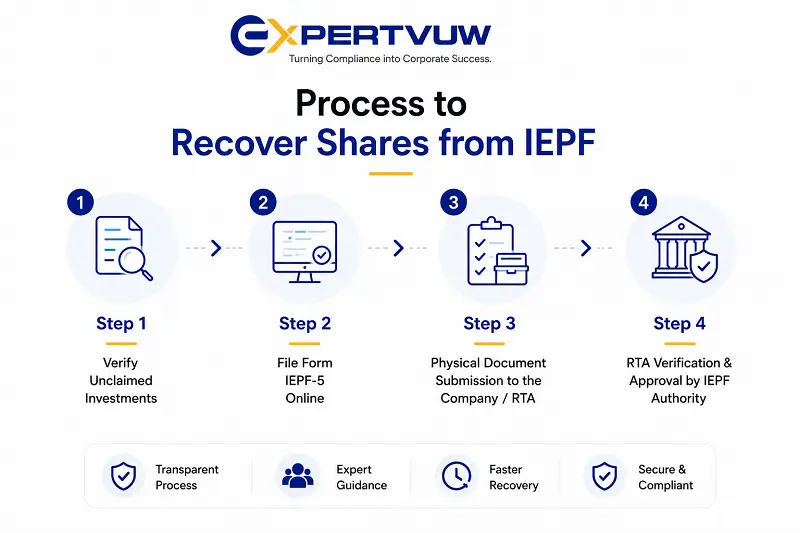
Step 1: Verify Unclaimed Investments
Verifying your investment details correctly is one of the most important stages of the IEPF Claim Services process. Even minor errors in investor information can delay your claim.
Before initiating a claim, confirm that your shares have indeed been transferred to the IEPF. You can verify this by checking the IEPF Unclaimed/Unpaid Amount Database on the official IEPF portal using your:
Investor Name
Folio Number / DP ID-Client ID
Company Name
Step 2: File Form IEPF-5 Online
Filing Form IEPF-5 accurately is essential for successful IEPF Share Recovery Services. Any mismatch in personal details, Demat information, or bank account details may result in unnecessary queries from the company or IEPF Authority.
1. Visit the MCA portal or the IEPF portal.
2. Register as a user and fill out e-Form IEPF-5 online.
3. Provide details including:
- Company Identification Number (CIN)
- Details of shares/dividends being claimed
- Claimant’s PAN, Aadhaar, and active Demat account details
- Bank account details linked with Aadhaar (for direct credit of dividends via NEFT)
4. Submit the form and download the generated SRN Acknowledgement Receipt.
Step 3: Physical Document Submission to the Company / RTA
Most applicants face delays because of incomplete documentation. Professional IEPF Claim Assistance ensures that all affidavits, indemnity bonds, and supporting documents are submitted correctly within the prescribed timeline.
Filing online is only half the process. Within 15 days of online filing, you must submit a physical set of verified documents to the Nodal Officer / RTA of the company.
Core Document Checklist for IEPF Claim:
- Printout of filled e-Form IEPF-5 with signature.
- Original SRN Acknowledgement Receipt.
- Original physical Share Certificate(s) (if claiming physical shares).
- Copy of PAN Card and Aadhaar Card (self-attested).
- Client Master List (CML) of your active Demat Account (duly stamped and signed by your DP).
- Original cancelled cheque showing your name, account number, and IFSC code.
- Indemnity Bond (executed on non-judicial stamp paper of appropriate value).
- Advance Stamped Receipt with revenue stamp signed by the claimant.
Special Cases: Transmission (Deceased Holders) & Name Mismatches
The recovery process becomes significantly more complex when additional legal parameters are involved:
- Transmission Cases (Claim by Legal Heir)
If the original shareholder has passed away, legal heirs must complete the transmission of shares before or alongside the IEPF claim. Additional documents required include:
- Original or notarized Death Certificate.
- Succession Certificate, Probate of Will, or Letters of Administration (depending on holding value and presence of a registered nomination).
- No Objection Certificates (NOC) from other legal heirs, along with affidavits.
2. Name Mismatch or Signature Mismatch
If the investor’s name on the share certificate does not exactly match the PAN or Aadhaar card (e.g., maiden name vs. married name, spelling variations, middle name missing), the RTA will issue a discrepancy query. Resolving this requires:
- Joint Affidavit for Name Variation.
- Gazette notification (in case of legal name change).
- Bank Manager’s attestation for signature verification.
Step 4: RTA Verification & Approval by IEPF Authority
Once the verification is successfully completed, the IEPF Authority credits the recovered shares directly to your Demat account. Choosing experienced IEPF Claim Services can significantly reduce documentation errors and speed up the recovery process.
1. e-Verification Report: The company’s Nodal Officer verifies the submitted physical documents against company records and submits an e-Verification Report to the IEPF Authority within 30 days.
2. Sanction & Transfer: Upon approval by the IEPF Authority:
- Unclaimed Dividends: Credited directly to your bank account via NEFT/RTGS.
- Shares: Credited directly to your Demat Account via corporate action.
Common Causes for IEPF Claim Rejections
Most claim rejections are avoidable with proper documentation and expert guidance. Professional IEPF Share Recovery Services help investors identify potential issues before submission, improving the chances of successful approval.
A high percentage of individual IEPF claims face delays or outright rejection due to:
- Incorrect mapping of Folio numbers or DP IDs in e-Form IEPF-5.
- Stamp paper value errors on Indemnity Bonds and Affidavits.
- Mismatched signatures between old company records and current bank records.
- Incomplete legal heir documentation in non-nominated transmission cases.
- Delay in submitting physical documents to the RTA post online filing.
How Expertvuw Can Help Recover Your Assets
Navigating company RTAs, MCA regulatory procedures, and legal documentation requirements can be overwhelming. Expertvuw Management Pvt. Ltd. offers comprehensive IEPF Claim Services to help investors Recover Unclaimed Shares efficiently. Our experienced Company Secretaries (CS) and legal professionals manage the complete recovery process from documentation to final approval.
Why Choose ExpertVuw for IEPF Claim Services?
Comprehensive Eligibility Audit: We track and verify all lost shares and dividend history across listed companies.
End-to-End Execution: From drafting IEPF-5 forms, Indemnity Bonds, and affidavits to handling physical delivery to RTAs.
Complex Case Expertise: Specialized in handling **Transmission of Shares**, NRI recovery, physical-to-demat conversions, and severe name/signature mismatches.
Direct RTA & Nodal Officer Liaisoning: We coordinate actively with RTAs and Nodal Officers to ensure fast-track submission of the e-Verification report.
Whether your case involves old physical share certificates, transmission, NRI investments, or unclaimed dividends, our IEPF Claim Services are designed to provide complete end-to-end assistance with maximum transparency and compliance.
Unsure if your family has unclaimed shares or dividends sitting with the IEPF?
Contact ExpertVuw today for professional IEPF Claim Services and a free portfolio assessment. Our experts help you Recover Shares from IEPF through a smooth, transparent, and hassle-free process.
Visit Expertvuw Management today for a free portfolio assessment and let our experts handle the paperwork for you.
Frequently Asked Questions (FAQs)
Q1. How long does the IEPF share recovery process take?
Typically, the recovery process takes anywhere between 3 to 6 months from the date of physical document submission to the RTA, depending on document accuracy and company verification timelines.
Q2. Can NRIs claim shares from the IEPF?
Yes. NRIs can claim lost shares from the IEPF. However, additional requirements such as NRE/NRO bank account mapping, FEMA compliance, and apostilled/attested documentation apply.
Q3. Is it mandatory to have a Demat account to claim IEPF shares?
Yes. Under current regulatory mandates, shares recovered from the IEPF cannot be issued in physical form they are credited directly to the claimant’s Demat account.
Q4. Should I use professional IEPF Claim Services?
If your case involves transmission, multiple folios, name mismatch, missing share certificates, NRI claims, or legal heir documentation, professional IEPF Claim Services can help reduce errors, ensure proper documentation, and improve the chances of successful recovery.