

There is something inexplicably nostalgic about the old-school share certificates, in that they seem so tangible. The paper certificates, the stamps, the handwritten folio number, and the name of companies that you would recall having studied Indian economics for many years now. They seem solid. Tangible. Important.
However, in 2026, that very certificate seems like a burden.
For one, it is prone to being misplaced or lost altogether. It cannot be traded in an electronic environment. It does not enjoy automatic corporate action. In addition, if dividends due on such certificates have remained unpaid for seven consecutive years, the dividend and the share itself will automatically revert to the Investor Education and Protection Fund.
The solution is straightforward: convert your physical shares to demat. The dematerialisation of shares is a well-defined, fully legal process that transforms your paper certificates into secure, electronically held assets in a demat account. Once done, your investment is safe, accessible, and ready for the modern market.
This guide walks you through every step of the physical shares to demat process in 2026 — including the critical SEBI special window that is currently open for investors who missed earlier transfer opportunities.
Why Physical Shares Need to Be Converted — And Why Now
Now let us move on to what is actually the legal requirement in India.
It is now mandatory by SEBI regulations that all securities of listed companies will have to be dematerialised from April 1, 2019. That means if an investor owns shares of any listed company in physical format and wishes to sell those, he will have to dematerialise those first. It is no longer possible for an investor to use the physical certificate of any listed company for doing any transaction because the physical shares would become frozen until they are dematerialised.
Beyond the regulatory requirement, the practical reasons to convert physical shares to demat are compelling:
Security — Physical certificates can be lost, stolen, damaged by fire or flood, or fade over time. Electronic holdings in a demat account are backed by two national-level depositories and are completely secure.
Accessibility — Once in demat form, you can view your holdings, receive dividends, access bonus shares, and trade from anywhere — including from your phone.
Automatic corporate actions — Dividends, bonus share allotments, rights issues, and stock splits are automatically credited to your demat account. With physical shares, you have to manually track and claim each of these.
No risk of IEPF transfer — Once shares are in demat form and dividends are credited electronically, the risk of unclaimed dividends — and the resulting IEPF transfer — drops dramatically.
Loan against shares — Physical shares cannot be pledged for loans. Demat shares can be pledged easily with lenders.
The SEBI Special Window of 2026 — A Critical Opportunity
Before going on to discuss how the dematerialisation of shares is to be done normally, there is one critical development in 2026 that must be known by all investors who have physical shares.
The Securities Exchange Board of India will give a one-year window period starting February 5, 2026 until February 4, 2027 to enable investors to make transfers and dematerialise the physical shares purchased or sold prior to April 1, 2019.
This window period will even cover the cases where the transfer applications were made before but refused, rejected, or not entertained because of any defect in the process or documentation.
This is very important. If you or your family members had previously tried to make a transfer of physical share certificates but the application was refused for any reason whatsoever, then this one-year window period provides a second chance.
Important conditions to note:
- The shares transferred via this special window can be credited only in demat form
- Shares which get transferred by way of this process will carry a compulsory lock-in of one year since the date of registration
- If the original share certificate is lost, then this particular special window is not applicable to such cases
- Shares which have been already transferred to IEPF are also excluded
If you have your physical shares with you and they have been bought or transferred before April 1, 2019, then this particular window ends on February 4, 2027. Do not miss out.
Understanding the Key Players in the Dematerialisation Process
Before walking through the steps, it helps to understand who is involved in the physical shares to demat conversion:
Depository Participant (DP) — Your main contact person. A depository participant is an entity through which you open and run your demat account. These include banks such as HDFC Bank, ICICI Bank, State Bank of India; stockbrokers like Zerodha, Angel Broking, and HDFC Securities. As the services of banks can be accessed through their branches, so also the services of a depository can be accessed through a DP.
Depository — The entity where your shares are stored electronically. There are two depositories in India registered with SEBI: NSDL (National Securities Depository Limited) and CDSL (Central Depository Services Limited). Based on which depository your DP is registered with, you have your demat account with either NSDL or CDSL.
Registrar and Transfer Agent (RTA) — The company’s record-keeper. The RTA maintains the register of members, verifies the authenticity of share certificates, and approves dematerialisation of shares requests. Major RTAs include KFin Technologies and Link Intime India.
ISIN — The International Securities Identification Number is a unique 12-digit code assigned to each company’s shares. You need the correct ISIN for each company whose shares you are dematerialising. If you use the wrong ISIN, your request will not go through. Ask your DP or check with the RTA to make sure you use the right ISIN for your shares.
Step-by-Step: How to Convert Physical Shares to Demat
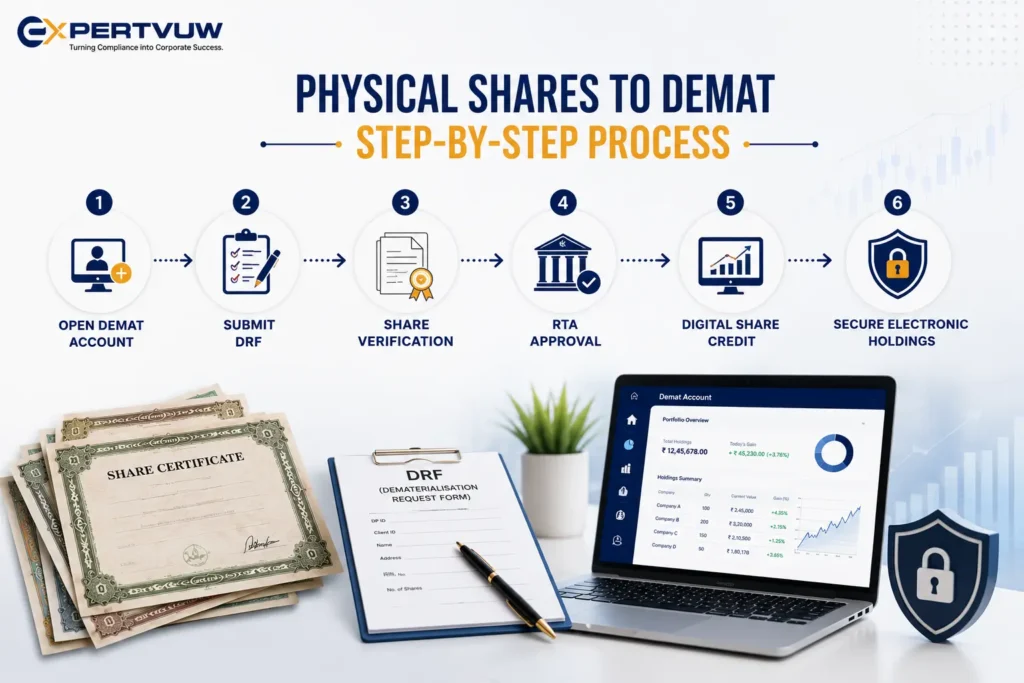
Step 1: Open a Demat Account
Opening a demat account, in case you don’t have an existing one, would be the first step that you need to take in order to transfer your physical holdings into demat format.
Some of the documents you need to provide for account opening purposes include the following:
- PAN card (compulsory)
- Aadhaar card
- Banking information (bank account number, IFSC code, etc.)
- Proof of address (Aadhaar card/passport/utility bill, etc.)
- Passport-size photograph
- Cancelled cheque
Account opening procedure is usually completed via an online route and takes 2 to 5 working days.
An important detail before opening: Make sure the name in your demat account matches your name on the physical share certificates exactly. The name on certificates should match your demat account name. Even a minor variation — an initial vs a full name, a missing middle name — can block the dematerialisation of shares process. If there is a discrepancy, you will need to either correct the demat account details or submit an affidavit explaining the variation before proceeding.
If you already have a demat account, verify that it is active. Dormant accounts need to be reactivated by completing KYC with your DP before you can receive shares.
Step 2: Obtain the Dematerialisation Request Form (DRF)
Visit your DP and fill out the Dematerialisation Request Form (DRF). This form includes your demat account information, the securities that need to be dematerialised, and other pertinent data.
You can also download the DRF from your DP’s website or request it in person at their branch. Most major DPs also allow you to initiate the DRF process through their online platforms or mobile apps.
Critical rule on DRFs: You need a separate DRF for each company’s shares. If you try to combine multiple companies into one form, it will be rejected.
So if you have physical shares to demat for five different companies, you need five separate DRFs — one for each company’s shares.
Step 3: Prepare and Mark Your Physical Share Certificates
Before submitting your physical certificates along with the DRF, you must write a specific phrase on each certificate:
You must mention the phrase “Surrendered for Dematerialisation” on each share certificate.
Write this clearly on the face of each certificate before submission. This small detail can save you from big delays. It prevents any possibility of the certificate being used for other purposes during the processing period.
Also ensure that:
- The certificates are in good condition — not torn, partially destroyed, or illegible
- All joint holders’ names are exactly as on the demat account (same names, same order)
- The certificate numbers and distinctive number ranges are clear and readable
If your certificates are damaged or torn, inform your DP before submitting. Damaged certificates may require a separate process — including a police complaint and indemnity bond — before dematerialisation can proceed.
Step 4: Submit the DRF and Certificates to Your DP
Submit the completed DRF along with the original physical certificates to your DP. Your DP will verify the documents and issue an acknowledgement receipt.
Preserve this acknowledgement receipt carefully because it is going to be a reference for the whole dematerialisation process.
At this stage, your DP will also generate a Dematerialisation Registration Number (DRN) — a unique reference number for the request. These details, along with your share certificates, are then sent to the Registrar and Transfer Agent (RTA) for processing.
Step 5: DP Verification and Forwarding to Depository and RTA
Upon approval, your DP then makes an electronic submission to the depository (NSDL or CDSL) for dematerialisation, while sending across the certificates physically to the RTA of the company.
The RTA plays the most important role. They will:
- Verify the genuineness of the certificates based on their records
- Verify the accuracy of folio number, certificate number, and serial number range
- Verify that the name on the certificate matches the dematerialisation account
- Accept or decline the dematerialisation request
In case any discrepancy is found — name does not match, signature does not match, or other certificate particulars do not match the records — then a query is raised and the request is sent back. This causes delay in the process. It is always better to resolve the discrepancies before submitting.
Step 6: Shares Credited to Your Demat Account
Once the process is completed, the shares will be cancelled and equal shares will be electronically transferred into your dematerialised account. You will be notified by your Depository Participant after the process is completed.
Starting now, you have only electronic shares. The certificates have been legally cancelled, which means that these do not represent any ownership in the company anymore. Your future dividends, bonus shares, rights issues, and all other corporate actions will be directly credited to your dematerialised account.
The entire dematerialisation of shares process — from DRF submission to demat credit — typically takes 15 to 30 working days, depending on the RTA’s processing speed and whether any discrepancies are raised.
What Documents Do You Need for the Dematerialisation Process?
Here is the complete document checklist for converting physical shares to demat:
For the demat account (if opening new):
- PAN card (self-attested copy)
- Aadhaar card (self-attested copy)
- Bank account details with cancelled cheque
- Address proof
- Passport-size photographs
For the DRF submission:
- Completed Dematerialisation Request Form (separate form per company)
- Original physical share certificates (marked “Surrendered for Dematerialisation”)
- Self-attested PAN card copy
- Self-attested Aadhaar card copy
For joint holdings:
- All joint holders must sign the DRF
- The demat account must have the same holders in the same order as the share certificate
- If the name order is different, a Transposition Form must also be submitted alongside the DRF
For holdings where one joint holder has passed away:
- Death certificate of the deceased holder
- Legal heir documentation (depending on the value of holdings)
- Request for deletion of the deceased holder’s name before proceeding with dematerialisation
Common Mistakes That Block the Dematerialisation Process
The physical shares to demat conversion process is not complicated — but it has several specific requirements where small errors cause big delays.
Name mismatch between certificate and demat account — The most common issue. If your name appears as “R.K. Sharma” on the certificate but “Rajesh Kumar Sharma” on your demat account, the RTA will flag it. Resolve the discrepancy before filing — either through a name correction at the DP or by submitting a supporting affidavit.
Using one DRF for multiple companies — Each DRF must cover only one ISIN. Multiple companies on a single DRF will result in rejection of the entire form.
Not writing “Surrendered for Dematerialisation” — Certificates submitted without this notation may be rejected or returned.
Wrong ISIN — Every company’s shares have a unique ISIN. Verify the correct ISIN with your DP or the company’s RTA before filing.
Joint holder order mismatch — If your share certificate lists “A and B” as joint holders but your demat account lists “B and A,” the names are in a different order and the request will be flagged. Submit a Transposition Form to resolve this.
Shares not admitted for dematerialisation — Some companies, especially unlisted, delisted, or very old ones, are not approved for demat by NSDL or CDSL. Check with your DP before starting the process. If your company’s shares are not admitted, you need to resolve this through the company or a specialist service before dematerialisation of shares can happen.
Damaged or illegible certificates — Torn, faded, or partially destroyed certificates require additional steps before dematerialisation — including a report to the DP, an indemnity bond, and coordination with the RTA. Do not try to submit damaged certificates as-is.
Physical Shares to Demat and the IEPF Connection
This is a relationship that is not well understood — but it is critically important.
If you hold physical share certificates and dividends on those shares have been going unclaimed for years, there is a real risk that both the dividends and the shares have already been — or will soon be — transferred to IEPF.
Once shares are transferred to IEPF, the dematerialisation of shares process does not apply. Instead, you need to file a formal IEPF claim using Form IEPF-5 on the MCA portal. The shares will be credited to your demat account directly upon IEPF approval — without going through the standard DRF process.
The sequence that matters:
If your shares are still with the company (not yet in IEPF) → Dematerialise immediately using the standard process described in this guide. Getting them into demat form also activates ECS-based dividend credit, preventing the seven-year unclaimed dividend clock from running further.
If your shares have already been transferred to IEPF → File an IEPF-5 claim. Our IEPF Claim Services handle this process end-to-end. Upon approval, shares are credited directly to your demat account.
If your share certificate is lost and shares are also in IEPF → You need our Duplicate Share Certificate Services first to obtain a Letter of Confirmation (LOC), then file the IEPF claim using that LOC as proof of entitlement.
Timeline for Physical Shares to Demat Conversion
| Stage | Estimated Time |
| Demat account opening (if new) | 2 to 5 working days |
| DRF preparation and certificate marking | 1 to 2 days |
| DP submission and DRN generation | Same day |
| DP forwards request to RTA | 1 to 3 working days |
| RTA verification and approval | 7 to 21 working days |
| Shares credited to demat account | 1 to 2 working days post-approval |
| Total (clean case, no discrepancies) | 15 to 30 working days |
Cases with name mismatches, damaged certificates, or companies that require additional verification can take longer — typically 45 to 60 days.
Physical Shares to Demat for NRIs
NRIs face a specific consideration when converting physical shares to demat: the demat account type.
As an NRI, you cannot receive shares in a regular resident demat account. You need either:
NRO Demat Account — For shares that cannot be repatriated abroad. Suitable for most inherited or long-held physical shares. Income (dividends) is subject to TDS at applicable rates.
NRI Demat Account — For repatriable holdings. Subject to FEMA guidelines.
If you had a resident demat account before moving abroad, contact your DP to convert it to NRO status before initiating the DRF process.
For NRIs submitting documents from abroad, signatures on the DRF and supporting documents may need notarisation and apostille (for Hague Convention countries) or Indian Embassy/Consulate attestation. A Power of Attorney granted to a trusted representative in India simplifies the process significantly.
Our Share Recovery Services include dedicated NRI support — managing the India-side coordination with DPs and RTAs so the physical shares to demat conversion process is completed correctly within the required timeframes.
Frequently Asked Questions on Physical Shares to Demat
Can I convert physical shares to demat without visiting the DP’s office?
Many DPs now offer online initiation of the dematerialisation of shares process. However, original physical certificates must still be physically submitted to the DP — they cannot be sent electronically. You can courier them to the DP with a covering letter, the signed DRF, and your acknowledgement details.
What if my physical share certificate is lost?
You cannot proceed with standard dematerialisation if the original certificate is missing. You must first apply for a duplicate share certificate through the company’s RTA — a process that involves an Affidavit-cum-Indemnity bond and, for high-value holdings, an FIR. Once the Letter of Confirmation (LOC) is issued by the RTA, you can use it to have shares credited to your demat account. Our Duplicate Share Certificate Services handle this entire process.
Is there a fee for dematerialising physical shares?
DPs may charge nominal fees for dematerialisation. However, the long-term benefits of electronic holdings outweigh the initial costs. Fee structures vary by DP — some charge per certificate, others per ISIN, and some have flat processing fees. Check with your DP before initiating.
What happens to corporate actions (dividends, bonuses) after dematerialisation?
Once your shares are in demat form and your bank account is linked, all dividends are credited electronically via NEFT/RTGS. Bonus shares and rights issue entitlements are automatically credited to your demat account. No manual tracking or claiming is required.
Can all physical shares be dematerialised?
Most listed company shares can be dematerialised. However, securities that have not been admitted for dematerialisation by NSDL or CDSL cannot be dematerialised. Some companies, especially unlisted, delisted, or very old ones, may not be approved. Check with your DP or the company’s RTA to confirm eligibility.
What is a Transposition Form and when is it needed?
If shares are held in joint names but the demat account has the same names in a different order, a Transposition Form must be submitted alongside the DRF. This resolves the order mismatch without requiring a formal name correction.
What if my company’s shares are already in IEPF?
Dematerialisation through the standard DRF process is not applicable for IEPF-held shares. You need to file an IEPF claim using Form IEPF-5. Upon approval, shares are directly credited to your demat account. Our IEPF Claim Services manage this entire process.
How do I know if my dematerialisation request has been approved?
Your DP will send you a confirmation once shares have been credited. You can also check your demat account holdings online or through your DP’s app. The DRN generated at submission can be used to track the status with your DP.
When to Use Professional Share Recovery Services for Dematerialisation
The standard physical shares to demat process is manageable on your own if:
- The certificates are in good condition
- The name on the certificate matches your demat account exactly
- The shares belong to a listed, admitted company
- You have an active demat account already set up
Professional Share Recovery Services become genuinely valuable when:
Certificate is lost — Requires the duplicate certificate process (our Duplicate Share Certificate Services) before dematerialisation.
Name mismatch — Requires affidavit, gazette notification, or marriage certificate to resolve before the RTA will approve.
Deceased holder — Requires transmission documentation before or alongside the dematerialisation request.
Shares already in IEPF — Requires IEPF-5 claim (our IEPF Claim Services) rather than the DRF route.
Unlisted or very old company — May require additional steps to confirm ISIN eligibility with NSDL or CDSL.
NRI — Requires NRO/NRE demat account setup, document authentication, and possible Power of Attorney coordination.
SEBI special window cases — Complex documentation requirements for pre-2019 share transfers that were previously rejected.
Our team handles each of these scenarios routinely — removing the guesswork and ensuring the dematerialisation of shares happens correctly and without unnecessary delay.
After Dematerialisation — What to Do Next
Once your shares are successfully converted to demat form, a few follow-up steps ensure everything is properly set up for the future:
Link your bank account — Ensure your demat account is linked to an active bank account for dividend credit via NEFT/RTGS. If it is not linked, dividends may still go unclaimed.
Update your PAN and Aadhaar — SEBI has mandated that all demat account holders must have their PAN and Aadhaar linked and updated with their DP. If not done, certain transactions may be frozen.
Register a nominee — A formal nomination on your demat account significantly simplifies the process for your family in case of your absence. Without a nominee, your family will need to go through a lengthy transmission process.
Consolidate multiple folios — If you held shares in the same company across multiple physical folios, check whether they have all been dematerialised under the same demat account. Consolidation simplifies future management.
Monitor dividend credits — After your first dividend cycle post-dematerialisation, confirm that dividends are being credited electronically. If they are not, contact your DP to verify the bank mandate is active.
Final Word
The journey from a physical share certificate to a demat account entry is not long. The physical shares to demat process is well-defined, legally robust, and in 2026, supported by SEBI’s special window for investors who missed earlier transfer opportunities.
What it requires is action. Every month that passes with physical certificates sitting in a filing cabinet is another month of unnecessary risk — from loss, from damage, from seven-year unclaimed dividend clocks ticking quietly in the background.
The investment you or your family made deserves to be in a format that protects it, grows with it, and makes it accessible whenever you need it. Dematerialisation of shares is that format.
Whether you complete the convert physical shares to demat process yourself or lean on our Share Recovery Services, Duplicate Share Certificate Services, and IEPF Claim Services for support — the most important step is simply to begin.
Your shares are ready to make the move. Are you? Start your physical shares to demat conversion today. Contact Us and our team will tell you exactly what you need to do first — +91 88829 91427 | +91 80768 85539 | info@expertvuw.in